Scientific Machine Learning
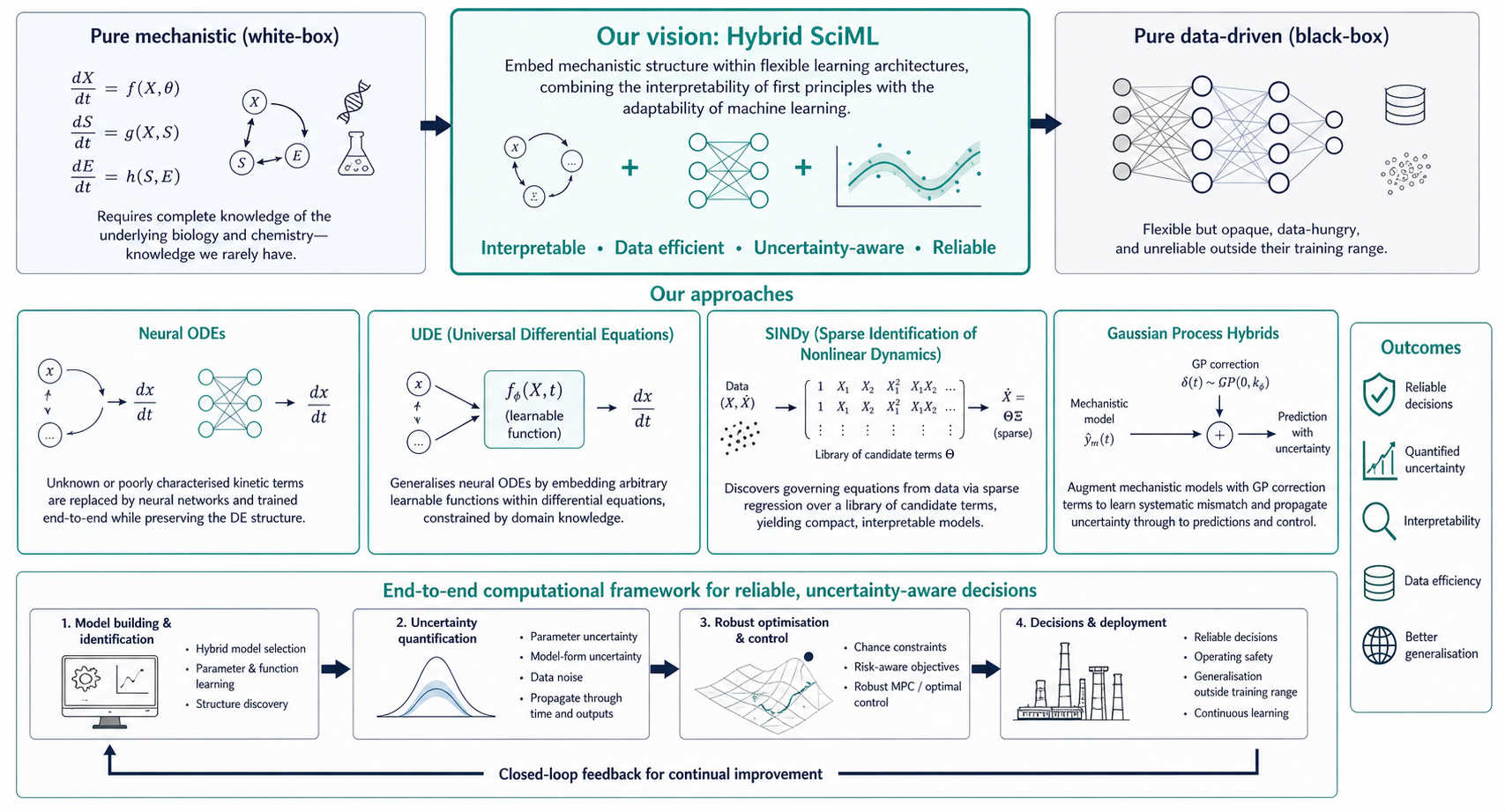
Pure mechanistic models require complete knowledge of the underlying biology and chemistry. But we rarely have complete knowledge. Pure data-driven models are flexible but opaque, data-hungry, and unreliable outside their training range. My research develops a third path: hybrid SciML frameworks that embed mechanistic structure within flexible learning architectures, combining the interpretability of first principles with the adaptability of machine learning.
The long-term goal is a comprehensive, end-to-end computational framework for making reliable, uncertainty-aware decisions using hybrid models: from model building and identification, through uncertainty quantification, to robust optimisation and control.
Approaches
Neural ODEs
Unknown or poorly characterised kinetic terms in mechanistic ODE systems are replaced by neural networks. The combined system is trained end-to-end, preserving the differential equation structure while learning what first principles cannot specify.
Universal Differential Equations (UDE)
A generalisation of neural ODEs where arbitrary learnable functions — not just neural networks — are embedded within differential equations. This allows domain knowledge to constrain the hypothesis space while data fills in the gaps.
SINDy (Sparse Identification of Nonlinear Dynamics)
Rather than assuming a fixed model structure, SINDy discovers governing equations directly from data by solving a sparse regression problem over a library of candidate terms. The result is a compact, interpretable equation rather than a black-box network. We have applied this to continuous direct compression processes with inherent delays, combined with Bayesian inference for uncertainty quantification.
Gaussian Process Hybrids
Mechanistic models are augmented with Gaussian process correction terms that learn systematic model-plant mismatch from data. Because GPs are probabilistic, this naturally propagates uncertainty through to predictions and control decisions.