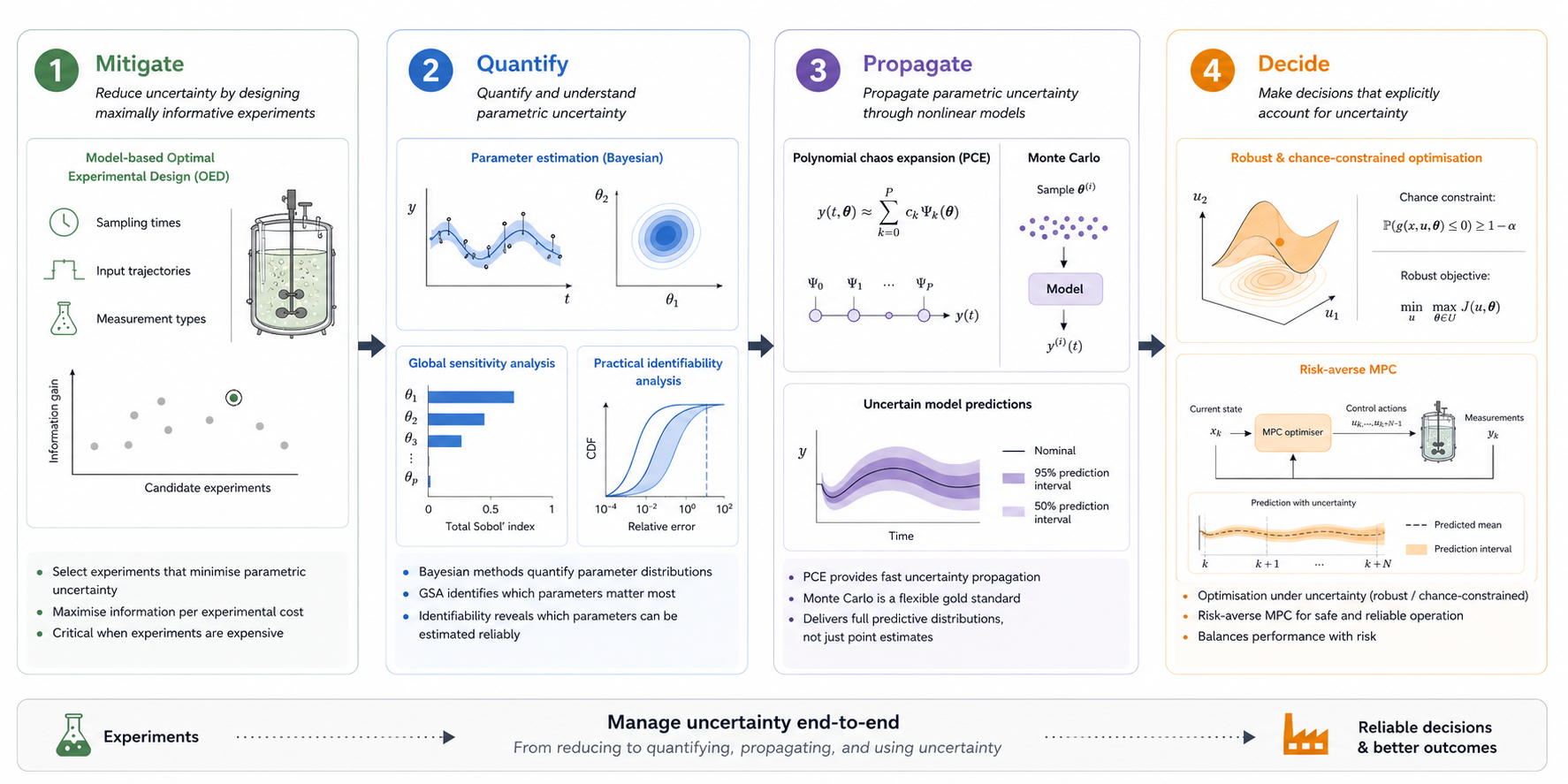
Pharmaceutical and bioprocess models are inherently uncertain: processes are often stochastic, parameters are estimated from noisy data, and the models themselves are approximations built on many assumptions. Ignoring this uncertainty leads to overconfident predictions and unreliable decisions. My research addresses uncertainty end-to-end — from reducing it experimentally, to quantifying and propagating it through models, to making decisions that explicitly account for it.
Mitigate
Uncertainty can be reduced before it is a problem by designing experiments that are maximally informative. I develop model-based optimal experimental design (OED) methods that select sampling times, input trajectories, and measurement types to minimise parametric uncertainty in the resulting model. This is especially important in pharmaceutical and bioprocess applications where experiments are expensive.
Quantify
Once a model is built, I quantify how uncertain its parameters are using Bayesian parameter estimation, global sensitivity analysis (GSA), and practical identifiability analysis. GSA tells us which parameters matter most; identifiability analysis tells us which can be estimated reliably from available data.
Propagate
Parametric uncertainty must be propagated through nonlinear models to obtain uncertain predictions. I use polynomial chaos expansions (PCE) and Monte Carlo methods, benchmarking their efficiency and accuracy across different process models — from population balance models for milling to kinetic models for fermentation.
Decide
Ultimately, uncertainty must inform decisions. I develop robust optimisation, chance-constrained optimisation, and risk-averse model predictive control (MPC) strategies that account for model uncertainty when computing optimal operating conditions or control actions.
Relevant Publications
Quillo, G., Bhonsale, S., Collas, A., Van Impe, J., & Xiouras, C. (2025). Hybrid semi-mechanistic and machine learning solubility regression modeling for crystallization process development.
CRYSTAL GROWTH & DESIGN,
25(4), 1111–1127.
https://doi.org/10.1021/acs.cgd.4c01451
Bhonsale, S., Nimmegeers, P., Akkermans, S., Telen, D., stamati, I., Logist, F., & Van Impe, J. (2022). Optimal experiment design for dynamic processes. In
Simulation and optimization in process engineering (pp. 243–271). Elsevier.
https://doi.org/10.1016/B978-0-323-85043-8.00010-6
Mores, W., Nimmegeers, P., Hashem, I., Bhonsale, S., & Van Impe, J. (2022). Multi-objective optimization under parametric uncertainty:
A Pareto ellipsoids-based algorithm.
Computers & Chemical Engineering,
169(108099).
https://doi.org/10.1016/j.compchemeng.2022.108099
Bhonsale, S., Mores, W., & Van Impe, J. (2021). Dynamic optimisation of beer fermentation under parametric uncertainty.
Fermentation-Basel,
7(4).
https://doi.org/10.3390/fermentation7040285
Bhonsale, S., Stokbroekx, B., & Van Impe, J. (2020). Assessment of the parameter identifiability of population balance models for air jet mills.
Computers & Chemical Engineering, (107056).
https://doi.org/10.1016/j.compchemeng.2020.107056
Nimmegeers, P., Bhonsale, S., Telen, L., & Van Impe, J. (2020). Optimal experiment design under parametric uncertainty: A comparison of a sensitivities based approach versus a polynomial chaos based stochastic approach.
Chemical Engineering Science, (115651).
https://doi.org/10.1016/j.ces.2020.115651
Bhonsale, S., Muñoz López, C., & Van Impe, J. (2019). Global sensitivity analysis of a spray drying process.
Processes,
7(9).
https://doi.org/10.3390/pr7090562
Bhonsale, S., Telen, D., Stokbroekx, B., & Van Impe, J. (2018). An analysis of uncertainty propagation methods applied to breakage population balance.
Processes,
6(12).
https://doi.org/10.3390/pr6120255